


If you’re reading this, chances are good that you are (or have been) the founder of something. You’re growing a SaaS product, most likely. You’re also likely to lean toward bootstrapping and funding the company with customer revenue, over raising money.
That means you run a tight ship, cut costs wherever you can, you focus on marketing as much as on product, and try to grow MRR profitably.
Great. That’s us, too!
And now, what do most startup bootstrappers do, when looking for ideas? Well, we often start with what everyone likes to do: we solve our own problems first.
But here’s the problem:
When you yourself are an indie hacker, and you are building products for other indie hackers, all of whom have four Claude Code windows open simultaneously and are addicted to exercising this newfound power we all have to build 10X faster than we used to be able to…
Now, all of these indie hacker customers of yours are hankering to build their own self-hosted, bare-bones version of whatever it is you want to sell them.
Not all of them, that’s for sure: SaaS founders definitely still spend money. We certainly do, across the Wildfront SaaS portfolio.
But there are a lot more hackers now for whom the build vs buy equation has changed relatively quickly, mostly in the last 12 months. And when it comes to simple and overpriced tools, ‘build it ourselves’ has become a more appealing option than ever.
For many founders, this is resulting in higher churn numbers than ever. And in downward pricing pressure:
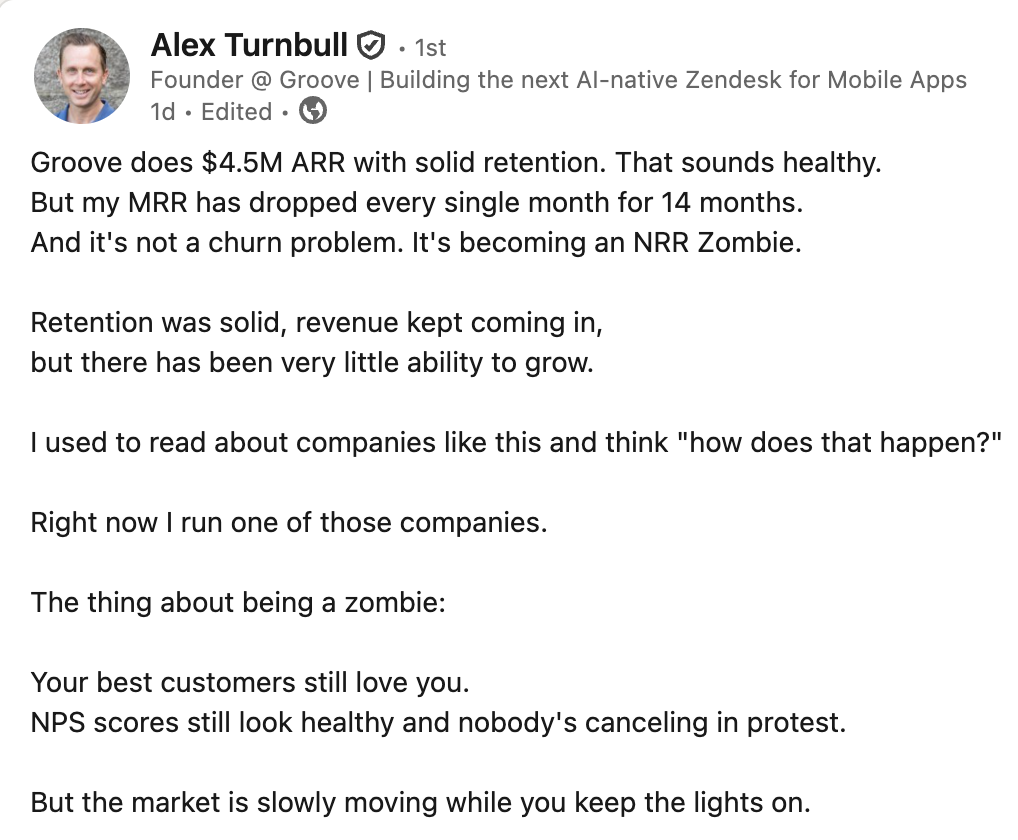
Alex is a very capable founder, so if he’s experiencing 14 months straight of net MRR losses? Dang, I can really feel that sting! Of course, I’m not saying his tools are simple or overpriced: I’m just validating this reality, if your business too is experiencing trouble with net-new MRR sales, or higher than average churn, if you sell to tech founders.
As always, though, there’s some good news:
Thankfully, most SaaS subscribers are not indie hackers.
I was in a group yesterday with seven people who own marketing agencies doing between $300k and $8M of annualized revenue.
I shared with them that we recently launched DemandBird, and I asked:
Would any of you consider building your own AI-coded social media tool in-house? Am I an idiot for putting a lot of my personal time and marketing effort into a scheduling and analytics tool?
To the former question: there was a unanimous chorus of, “absolutely not.” Shaking heads, and looks of exhaustion and despair rolled across the room at the mere suggestion of it.
Even moreso, they thought that a simpler, better, more affordable scheduling tool sounded sorely needed in the market!
So why aren’t these non-SaaS founders systematically vibe coding replacements for all of their tools?
Because their businesses are already demanding and complex enough as things stand, without increasing their workload and difficulty level further. The market remains tough enough for them, without adding more stuff to their plate.
They’re focused on finding another $500k-2M of annual revenue in the next six months in a difficult climate, not on getting lost down the rabbit hole of developing a whole new set of skills (UI, UX, CI/CD, Claude Code, API management, you name it…).
These people have personal incomes of at least $300k-1M/yr, often more than that when you count equity buildup. To them, saving $29/mo to have a worse experience and to be their own product support team, is frankly below their pay grade.
Personally, I fall into the income bucket I’ve just described. I am frugal. But I’ve spent $29 on a cup of soup and a piece of fresh bread (Iceland prices, anyone?! That actually is indeed what we paid, at a little cafe in Grindavik…). I’m just not vibe coding something, and committing myself to maintaining it, to save a couple hundred bucks a year.
The prize has to be bigger than that.
SaaS is becoming a mature business model, not a pool of easy money
Now, I’m not saying that all you have to do is “not sell to indie hackers” and you’re in for a smooth ride. No way.
It helps to sell to non-SaaS customers, that’s for sure. They’re less likely to take on, let alone enjoy, the process of vibe coding a replacement for your tool.
But now your competition has become other indie hackers wanting that same non-SaaS tool budget. And it’s easier than ever for them to build a simple tool that competes for it.
(The remaining difficulty, of course, is the customer side: sales, marketing, support, distribution, and all of that. We’ve written extensively about that.)
Things are different today. In the old days of 2012-2021: if you spent time building a complex enough product, that used to be a real moat. It was difficult for your competitors to catch up to you.
You could afford to slow down engineering velocity, allow meeting bloat to infect your product development pipeline, and just not ship very fast or care that much. And you could do this while cash-flowing at a healthy clip, and not have much to worry about.
To be fair: the beginning of getting a SaaS off the ground has always been hard… but it used to be smoother sailing once you were established and north of even, say, ~$50k MRR or so.
In 2026?
You can still win. Absolutely. But it’s a lot harder to win while sitting on your laurels than it used to be. Even when selling to non-SaaS customers. (But as I argue, this difficulty doubles if you sell to other indie hackers!)
So you just can’t really stop performing at a high level anymore.
If you stop listening to customers, if you stop providing world-class support, if you don’t innovate or build new functionality, if your UI looks like it’s from 2012?
You used to be able to make do with that.
But not these days.
It’s not a SaaSpocalypse, it’s a SaaS Cambrian Explosion
Far from the death of SaaS: instead what we’re seeing is an explosion of SaaS. And even when Claude pulls the subsidies and starts charging full price, it’ll always be cheaper than it ever was before, for people to make new tools to cover new use cases that were previously not worth the effort to cover.
Nevertheless, I firmly believe that SaaS is far from a lost cause. It’s a great business. (If it wasn’t, Mac and I wouldn’t be spending almost all of our time in it!) And yes, you can tip the odds in your favor by selling solutions to customers who aren’t nearly as interested in AI coding as you are.
But regardless of who your customers are: the bar has gone up. It’s easier than ever for others to compete with you. Your product quality must be high, and your company must be easy to do business with.
You need to be clever and strategic about who you choose to build for.
I don’t mean that I think you should give up: I just mean that the game has changed.
These days, you need to plan to keep giving it your all. Not just in the beginning. But for the entire lifecycle of the company. Or at least until you cash out and you’re no longer the owner.
But not before then.
woah... feel like this resonated with him so much. it described things i've been feeling/experiencing so well.